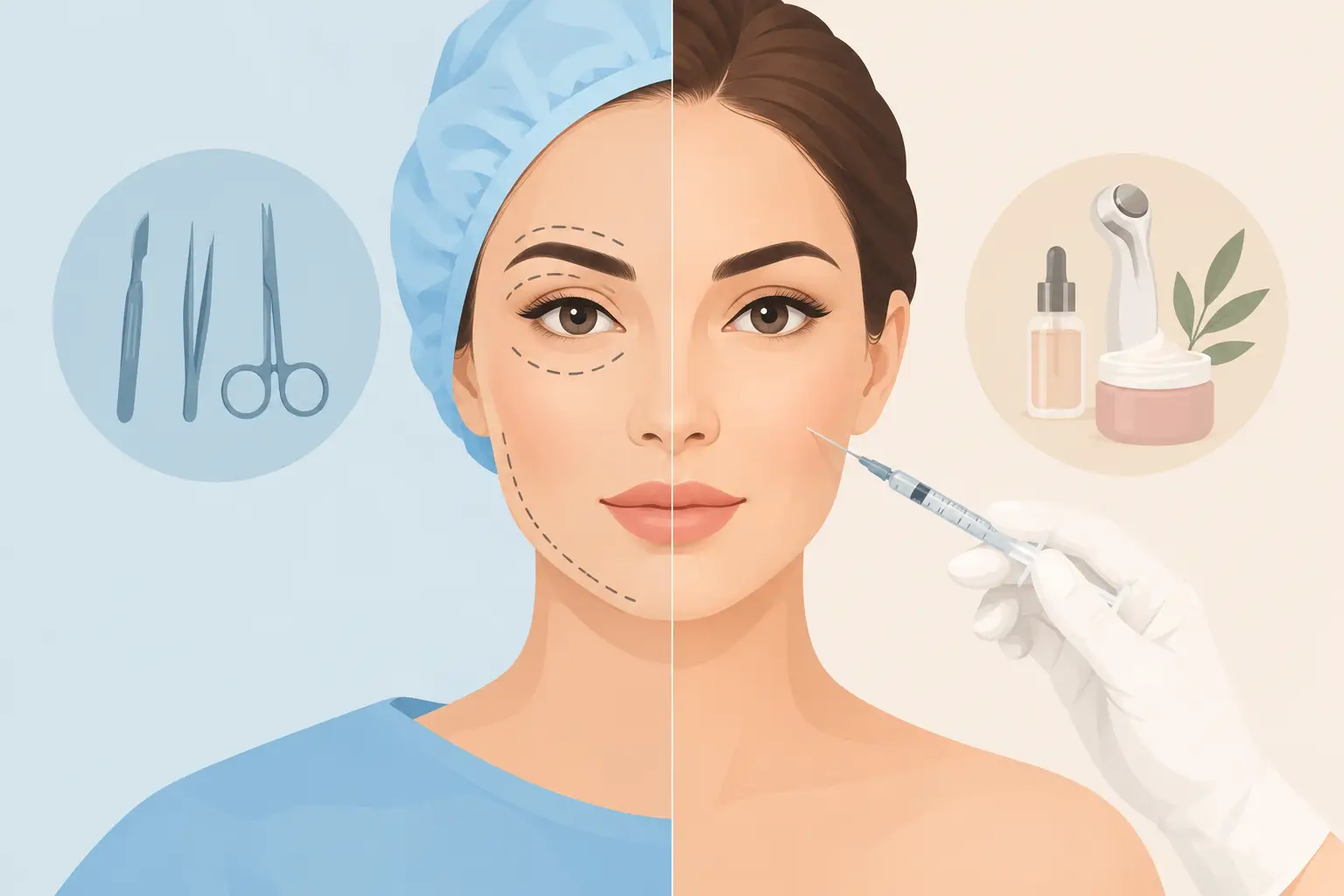
A sharper jawline, smoother skin, or a more rested expression can all be meaningful goals. The question is not simply which treatment is most popular, but which approach can create a result that remains elegant, proportionate, and appropriate for your anatomy. When considering surgical versus nonsurgical facial treatments, the right decision begins with an honest assessment of facial aging, skin quality, structural changes, and the level of correction you expect.
For patients who value refined outcomes, the choice should never be reduced to downtime alone. Surgical and nonsurgical treatments serve different clinical purposes. In many cases, the most sophisticated plan may combine both over time.
Surgical Versus Nonsurgical Facial Treatments: The Core Difference
Facial aging is not limited to wrinkles. Skin loses elasticity, fat compartments shift, volume changes, and the deeper support structures of the face gradually descend. Nonsurgical treatments can improve selected signs of aging, while surgery is designed to reposition or remove tissue when laxity and structural change are more advanced.
What facial surgery can address
Procedures such as facelift surgery, neck lift surgery, eyelid surgery, brow lift surgery, and facial fat grafting offer structural correction. A well-planned facelift, for example, can reposition deeper facial layers and refine the jawline and neck in a way that injectables cannot replicate. Blepharoplasty can remove or redistribute excess eyelid skin and fat, creating a more open, rested eye area when puffiness or skin redundancy is present.
Surgical treatment requires anesthesia, a defined recovery period, and careful postoperative follow-up. Its advantage is precision at a deeper anatomical level. Results are typically more substantial and longer-lasting, particularly for patients with visible jowls, marked neck laxity, pronounced lower-face descent, or excess eyelid skin.
The goal of advanced facial surgery is not to make a patient look altered. It is to restore definition, balance, and vitality while preserving the features that make the face recognizable.
What nonsurgical treatments can address
Nonsurgical facial treatments include neuromodulators, dermal fillers, biostimulators, laser and energy-based treatments, chemical peels, and skin-focused protocols. These options can soften dynamic lines, restore selective volume, improve texture, stimulate collagen, and enhance facial contours with little to no interruption to daily life.
Neuromodulators are often effective for expression lines in the forehead, between the brows, and around the eyes. Fillers may improve contour in areas such as the cheeks, chin, lips, or jawline when used with restraint and anatomical expertise. Collagen-stimulating treatments can support gradual improvements in skin quality and volume.
These treatments do not remove significant excess skin or lift deeper descended tissue. Attempting to use large amounts of filler to compensate for a surgical concern can create heaviness, distortion, or an overfilled appearance. The most natural outcome often comes from respecting the limits of each technique.
Results, Longevity, and Recovery
For many patients, the central comparison is between immediate convenience and long-term correction. Nonsurgical treatments are generally performed in an office setting and may involve minimal downtime. Mild swelling, redness, or bruising can occur, especially after fillers or energy-based procedures, but most patients return quickly to professional and social routines.
Their longevity varies. Neuromodulator results commonly last several months. Fillers may last from months to more than a year, depending on the product, treatment area, metabolism, and technique. Collagen stimulation develops gradually and typically requires a series or maintenance plan. These treatments can be highly effective, but preserving the result requires ongoing care.
Surgical recovery is more deliberate. Swelling and bruising are expected in the early period, and patients should plan time away from demanding social, professional, and travel commitments. While visible recovery progresses over several weeks, refinement continues as tissues settle. A facial procedure can provide results that endure for years, though it cannot stop the natural aging process.
This distinction matters for patients evaluating overall value. A nonsurgical approach may be ideal for a discreet enhancement before a milestone event, as an early intervention, or as maintenance after surgery. For a patient seeking a meaningful improvement in laxity, repeated nonsurgical procedures may ultimately be less satisfying than a single, well-executed surgical solution.
Choosing the Right Level of Correction
Age alone does not determine candidacy. Some younger patients have genetic under-eye bags, a weak chin, or early neck fullness that may benefit from a focused surgical procedure. Others in their fifties or sixties may have excellent skin quality and prefer conservative nonsurgical maintenance. The decision depends on what is happening beneath the surface.
Skin quality is one factor. Thick, resilient skin may respond differently to treatments than thin, sun-damaged skin. Bone structure, volume loss, degree of tissue descent, previous procedures, medical history, and lifestyle also shape the treatment plan. Smoking, certain medications, unstable weight, and untreated medical conditions can affect both candidacy and healing.
Your desired result is equally important. If your goal is to look subtly refreshed, with no surgical downtime, injectables and skin treatments may align well with your expectations. If you want a sharper neckline, correction of jowling, or an enduring improvement in lower-face laxity, surgery may offer the more direct path.
A credible consultation should include a frank discussion of what each option can and cannot achieve. Promises of a “nonsurgical facelift” deserve particular scrutiny. Some nonsurgical treatments can create a temporary lifting effect or improve skin firmness, but they are not equivalent to surgical repositioning when substantial laxity is present.
Safety Is Part of the Aesthetic Result
Facial procedures demand detailed knowledge of anatomy, technical judgment, and an uncompromising approach to safety. This is especially true with injectables, which are often perceived as simple because they are minimally invasive. Vascular complications, asymmetry, poor product selection, and overcorrection are real risks when treatments are not performed by appropriately qualified medical professionals.
Surgery introduces a different set of considerations, including anesthesia, bleeding, infection, scarring, nerve injury, and healing variability. These risks should be discussed clearly, without minimizing them. The appropriate setting, anesthetic support, sterile protocols, and postoperative access are integral to a high-standard surgical experience.
For international patients, planning should also account for travel. Arriving with adequate time before surgery, remaining locally for recommended follow-up, and avoiding premature air travel are practical components of responsible care. A premium medical tourism experience should be organized around clinical priorities, not a rushed itinerary.
At Dr. Hebert Lamblet American Hospitals, Brazilian surgical expertise is paired with a modern hospital environment in Tirana, Albania, supporting patients who seek an elevated standard of facial aesthetic care with European standards of infrastructure and safety.
When Combination Treatment Makes Sense
The choice is not always surgery or nonsurgical care. A patient may undergo a facelift or eyelid procedure to address structural aging, then use neuromodulators, skin resurfacing, or conservative volume restoration to maintain skin quality and expression balance. This approach can be more refined than relying on any single modality.
Likewise, nonsurgical treatment can be a thoughtful first step for patients who are not ready for surgery, have early signs of aging, or want time to understand how subtle changes affect their appearance. It can also help establish a long-term relationship with a medical team before considering a procedure.
The best plans are individualized rather than product-driven. They prioritize facial harmony, avoid unnecessary intervention, and evolve as a patient’s features and goals change.
A Decision Worth Taking Seriously
Before choosing treatment, consider the result you want to see in the mirror one year from now, not only the amount of downtime you hope to avoid this month. Ask whether the proposed treatment addresses the actual cause of your concern, how long the result is expected to last, what maintenance it requires, and who will manage your care if recovery does not follow the expected course.
A private consultation with a qualified plastic surgeon offers the clarity that online comparisons cannot. The most rewarding facial treatment is not necessarily the least invasive or the most extensive. It is the one selected with clinical precision, performed in the right setting, and designed to make you look confidently like yourself.