Most women have some degree of breast asymmetry. What matters is not whether the breasts are perfectly identical, but whether the difference is noticeable enough to affect clothing fit, body confidence, or comfort. When patients begin researching breast asymmetry correction options, they are usually looking for more than symmetry alone. They want proportion, natural movement, and a result that feels elegant rather than overdone.
That distinction matters. Correcting asymmetry is rarely a one-size-fits-all procedure. It requires careful surgical planning, an experienced aesthetic eye, and a clear understanding of what is creating the imbalance in the first place.
What causes breast asymmetry?
Breast asymmetry can appear in several ways. One breast may be larger than the other, sit higher on the chest, have a different shape, or show a noticeable variation in nipple position. In some patients, the issue is mostly volume. In others, it is the skin envelope, the breast base, the inframammary fold, or the chest wall anatomy.
Some asymmetry is developmental and becomes more visible after puberty. Other cases become more pronounced after pregnancy, breastfeeding, weight fluctuations, or aging. There are also patients with tuberous breast deformity or congenital differences that require a more advanced surgical approach.
This is why a high-level consultation is so important. The best treatment plan starts with an accurate diagnosis, not a standard package of procedures.
Breast asymmetry correction options depend on the anatomy
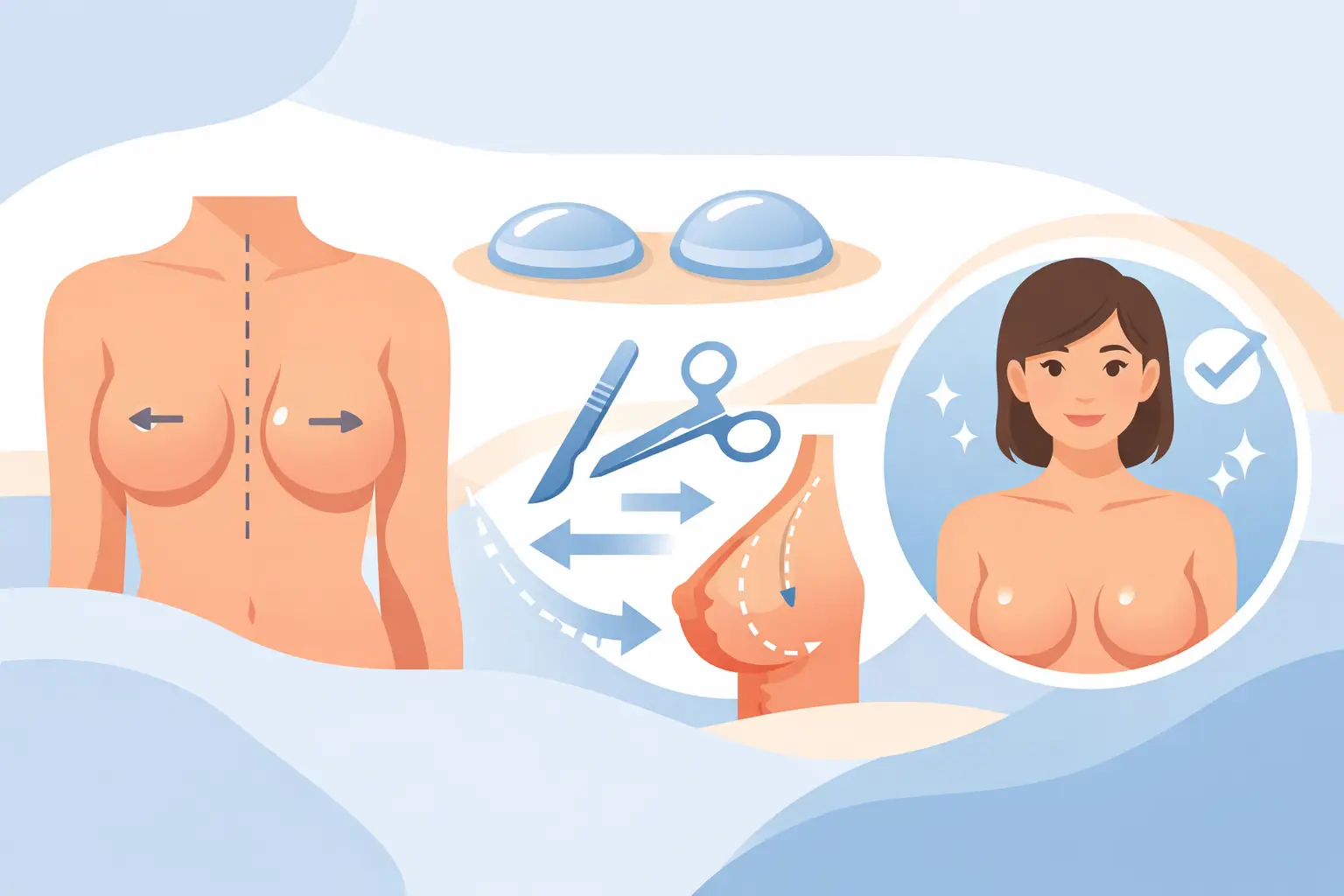
When patients search for breast asymmetry correction options, they often expect a single answer. In practice, the right approach depends on what needs to be corrected. A surgeon may need to adjust one breast, both breasts, or combine procedures to create a balanced result.
A premium surgical plan focuses on harmony rather than mathematical sameness. The goal is improvement that looks refined in motion, in clothing, and in proportion to the rest of the body.
Implants for volume differences
If one breast is smaller than the other, implants can help equalize volume. This may involve placing an implant in one breast only, or using two different implant sizes to create better balance.
This option works well when the primary issue is size discrepancy and the skin quality is good. It can also be effective for patients who want fuller upper-pole volume in addition to improved symmetry.
The trade-off is that implants address volume more directly than shape irregularities caused by droop, breast base asymmetry, or nipple position. If those factors are present, implants alone may not be enough.
Breast lift for position and shape
When one breast sits lower than the other, or when nipple height is uneven, a breast lift may be the most important part of the correction. A lift reshapes the breast tissue, repositions the nipple-areola complex, and removes excess skin.
In asymmetry cases, a lift can be performed on one side or both sides with different adjustments. This is often necessary when the breasts have similar volume but differ in projection, contour, or degree of sagging.
A lift improves architecture, not just size. That makes it especially valuable for patients who want a more sophisticated result rather than simply a fuller chest.
Reduction when one breast is significantly larger
For patients with one noticeably larger breast, reduction may be the most effective choice. This can relieve physical discomfort while improving visual balance. In some cases, one breast is reduced and the other is lifted or augmented to match.
This is a very individualized decision. Some patients want to preserve as much volume as possible, while others are more concerned with lightness, posture, and ease in clothing. The best plan depends on lifestyle, body frame, and aesthetic preference.
Fat transfer for subtle refinement
Fat grafting can be an excellent tool for mild asymmetry or for fine-tuning after another breast procedure. It uses the patient’s own fat to improve contour, soften transitions, or correct smaller volume differences.
The advantage is a natural feel and the ability to treat localized irregularities with precision. The limitation is that fat transfer usually offers modest volume enhancement compared with implants, and some of the transferred fat may not survive long term.
For the right patient, however, it can be one of the most elegant solutions available.
Combining procedures often creates the best result
Many of the most successful asymmetry corrections involve more than one technique. A patient may need an implant on one side and a lift on the other. Another may benefit from bilateral augmentation with different implant sizes plus pocket adjustments. In more complex cases, reduction, lift, and fat transfer may all play a role.
This is where surgical judgment becomes decisive. Breast symmetry is not created by choosing a popular procedure. It is created by reading the anatomy carefully and designing each step around it.
At a world-class level, the plan should account for chest width, tissue thickness, skin elasticity, nipple position, and long-term balance, not just what looks improved immediately after surgery.
What realistic results look like
Patients often ask whether surgery can make the breasts perfectly identical. The honest answer is no. Human anatomy is not perfectly symmetrical, and surgery should not promise an artificial standard that the body itself does not follow.
What excellent surgery can do is make asymmetry significantly less noticeable. It can improve balance in and out of clothing, restore proportion, and create a result that looks natural to the patient’s frame.
That level of refinement usually matters more than perfection. In aesthetic breast surgery, believable beauty is almost always more sophisticated than obvious correction.
Recovery and decision factors
Recovery depends on the procedure or combination of procedures performed. Patients treated with implants may experience tightness and swelling early on, while those undergoing lift or reduction will also need to manage incision healing and temporary shape changes as the tissues settle.
The final result takes time. Early asymmetry during recovery does not necessarily reflect the outcome, because swelling can resolve at different rates on each side. This is another reason patients should choose a surgical team that values structured follow-up and precise postoperative guidance.
Before moving forward, it is worth considering a few practical factors: how visible the asymmetry is in daily life, whether the issue is volume or shape, tolerance for scars, willingness to have implants, and the importance of long-term maintenance. Some patients prioritize fullness. Others prioritize softness, discretion, or minimal intervention. There is no universal best option, only the best option for a specific anatomy and goal.
Breast asymmetry correction options for complex cases
Some asymmetry cases are more advanced and should be treated accordingly. Tuberous breasts, significant chest wall differences, constricted lower poles, or previous breast surgery can all make correction more technically demanding.
These cases require more than standard cosmetic planning. They call for a surgeon with experience in both aesthetic detail and reconstructive thinking. The difference is visible in how the breast fold is managed, how lower-pole shape is released, and how the final contour is built with intention rather than approximation.
For international patients especially, choosing a premium medical setting matters. Sophisticated breast surgery benefits from high surgical standards, advanced imaging and planning, and a hospital environment designed for safety and discretion. At Dr. Hebert Lamblet American Hospitals, that philosophy aligns Brazilian expertise in aesthetic surgery with European standards of care, which is exactly the level of trust many patients seek when making a deeply personal decision.
Choosing the right consultation
A strong consultation should feel precise, not rushed. You should leave understanding what kind of asymmetry you have, which procedure is being recommended, what scars or trade-offs are involved, and what level of improvement is realistic.
You should also feel that the plan was built for you, not pulled from a standard menu. In breast surgery, customization is not a luxury. It is the basis of a credible result.
If breast asymmetry has been affecting how you dress, how you see your body, or how confident you feel, the right next step is not guessing which procedure sounds best. It is getting a thoughtful evaluation from a surgeon who can translate anatomy into a balanced, refined outcome.