For many patients, reaching a significant weight-loss goal is a defining achievement. Yet loose skin on the upper arms can remain long after the scale stabilizes, changing how clothing fits and how confidently the body feels in motion. An arm lift after weight loss is designed to address this concern with a more refined, lasting approach to upper-arm contour.
Also called brachioplasty, this procedure removes excess skin and, when appropriate, localized fat from the area between the underarm and elbow. The goal is not simply to make the arms smaller. It is to create a smoother, firmer silhouette that feels proportionate to the patient’s new body shape while respecting the natural anatomy of the arm.
Why upper-arm skin does not always tighten
Skin has an impressive ability to adapt, but that capacity has limits. After major weight loss, the collagen and elastic fibers that once supported the upper arm may not contract fully. Age, genetics, sun exposure, the amount of weight lost, and how long the skin was stretched all influence the degree of laxity that remains.
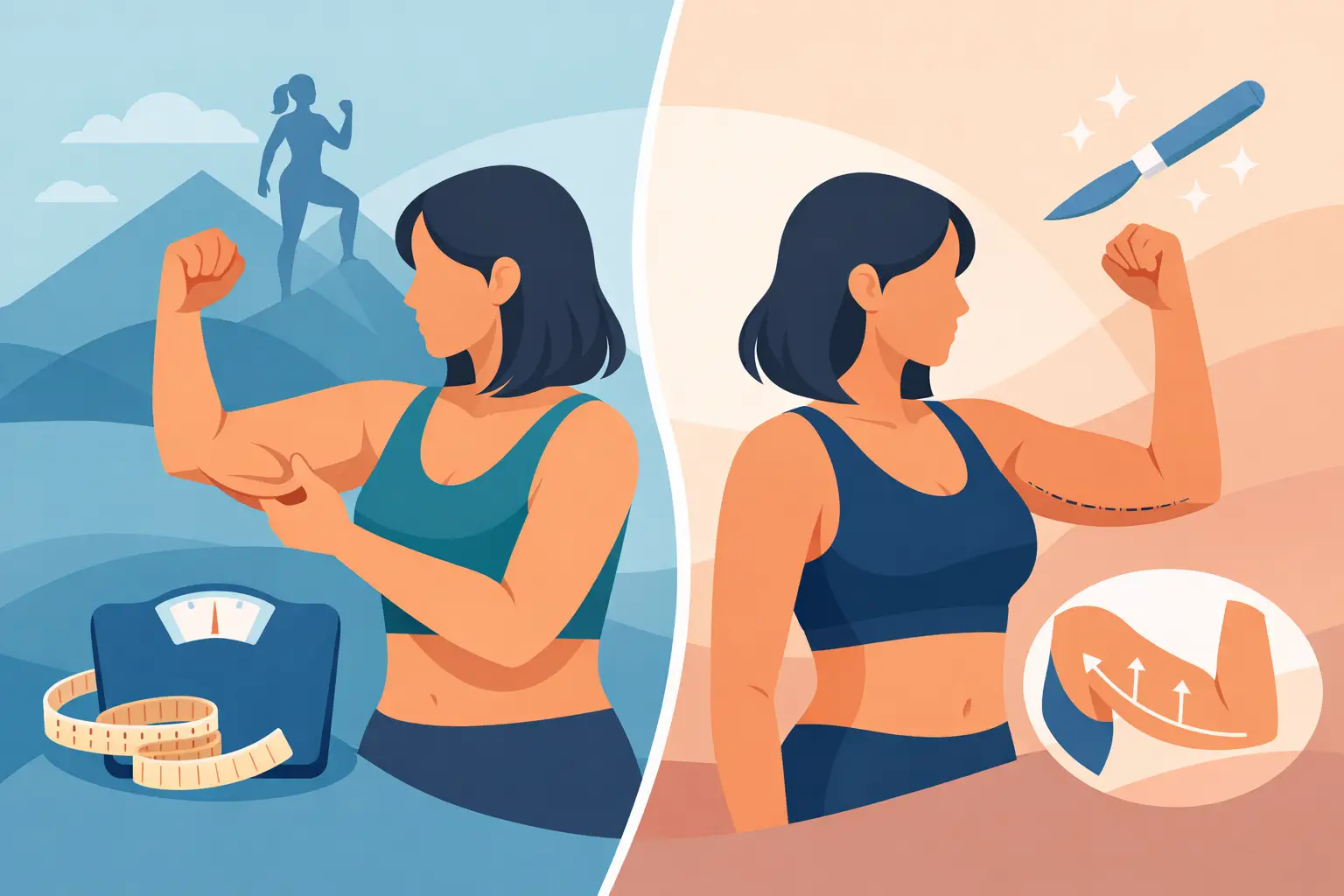
Exercise builds muscle and supports overall body composition, but it cannot remove a substantial skin envelope. This distinction matters. Patients sometimes spend months focusing on arm-strengthening routines only to find that the concern is not muscle tone, but excess skin that has lost its ability to retract.
An arm lift can be especially valuable when loose skin creates friction, irritation, difficulty finding tailored clothing, or self-consciousness in sleeveless styles. The best candidates are not pursuing an abstract ideal. They are looking for a body contour that better reflects the work they have already done.
Who is a good candidate for an arm lift after weight loss?
Candidacy depends on more than the appearance of the arms. A qualified plastic surgeon evaluates the quality of the skin, the distribution of residual fat, the position of the underlying tissues, scars from prior procedures, and the patient’s overall health. Medical history, medications, smoking or nicotine use, and realistic expectations are all part of a responsible surgical plan.
Most patients are best served when their weight has been stable for several months. For those who have undergone bariatric surgery or experienced a dramatic natural weight reduction, stability is particularly important. Continued weight loss after brachioplasty can create new laxity and affect the longevity of the result.
A patient may be an excellent candidate if they are in good general health, maintain a stable lifestyle, and are prepared to follow recovery instructions carefully. Equally important is accepting the central trade-off of the procedure: meaningful skin removal requires an incision and therefore a scar. In experienced hands, the scar is positioned as discreetly as anatomy allows, commonly along the inner or back portion of the arm, but it does not disappear.
The scar is a real part of the decision
Premium surgical planning does not minimize this point. A short-incision arm lift may be suitable for limited laxity near the underarm. More substantial skin excess usually requires a longer incision extending toward the elbow. In select post-weight-loss cases, an extended technique may be considered when laxity continues into the side of the chest.
The choice is based on what will create the most balanced contour, not on promising the smallest possible incision. A scar that is appropriately placed and properly cared for is often a worthwhile exchange for patients who want a significant improvement in arm shape. However, anyone unwilling to accept a visible scar should discuss non-surgical alternatives and their limitations honestly.
What happens during brachioplasty
Arm lift surgery is individualized. After carefully marking the treatment area, the surgeon makes incisions designed around the patient’s degree of laxity and desired contour. Excess skin is removed, deeper tissues may be reshaped or supported, and limited liposuction may be used when localized fat contributes to fullness.
Liposuction alone can improve contour when skin elasticity is still strong. After substantial weight loss, however, removing fat without addressing loose skin may leave the upper arm looking more deflated. This is why the procedure often combines contouring with excision rather than relying on one technique for every patient.
Brachioplasty is typically performed under general anesthesia in an accredited hospital setting. The duration varies with the complexity of the operation and whether it is combined with another body-contouring procedure. Combining surgeries can be appropriate for carefully selected patients, but it is not automatically the better choice. Longer operating times, recovery demands, and safety considerations must be weighed against the convenience of a single surgical experience.
A recovery plan built around precision
Recovery is an active phase of treatment, not an afterthought. Swelling, bruising, tightness, and temporary changes in sensation are expected in the early period. Compression garments are often used to support the healing tissues and help manage swelling. Patients should keep their arms protected, avoid lifting, and follow the surgeon’s instructions regarding showers, garment use, and incision care.
Many patients can manage light daily activities within one to two weeks, depending on the extent of surgery and the nature of their work. Driving, exercise, heavy lifting, and overhead movements generally require more time. Return to unrestricted training should be based on surgical guidance rather than a fixed date on a calendar.
The arms will look different immediately, but final refinement takes patience. Swelling resolves gradually, scars mature over many months, and the tissues continue to settle. Consistent aftercare, sun protection, stable weight, and avoiding nicotine all support the quality of healing.
For international patients, the recovery plan should be discussed before travel is booked. Postoperative monitoring, a comfortable local stay, mobility during the initial healing period, and safe timing for the return flight deserve the same attention as the operation itself. A world-class aesthetic result is supported by thoughtful coordination before and after surgery, not by rushing the journey home.
How to prepare for a high-level consultation
A meaningful consultation should feel more like strategic planning than a sales conversation. The surgeon should ask about your weight-loss history, prior surgeries, health conditions, medications, lifestyle, and the specific moments when arm laxity affects your confidence or comfort. Photographs may be used for evaluation and surgical planning, particularly for patients traveling from abroad.
Come prepared to discuss what you want to change, but also what you are willing to accept. Would a longer scar be acceptable for a more comprehensive improvement? Are you considering breast, abdominal, or thigh contouring as part of a broader post-weight-loss plan? Do you have a timeline tied to work, travel, or a major event? These details shape the safest and most elegant recommendation.
You should also expect a transparent conversation about risk. Like any surgery, brachioplasty carries potential risks including bleeding, infection, fluid accumulation, delayed healing, asymmetry, unfavorable scarring, numbness, and the possible need for revision. A serious surgical team discusses these possibilities clearly because informed decisions are part of excellent care.
At Dr. Hebert Lamblet American Hospitals, Brazilian surgical expertise is paired with European hospital standards to support patients seeking sophisticated body contouring in an international setting. The emphasis is on a personalized plan, rigorous medical evaluation, and a recovery experience designed around safety, discretion, and aesthetic precision.
Results that honor the weight-loss journey
The most successful arm lift results look integrated with the rest of the body. The arms appear lighter, smoother, and more proportionate, without looking over-tightened or surgically exaggerated. Clothing often fits more comfortably, and many patients feel more at ease wearing short sleeves, fitted jackets, and eveningwear.
Still, surgery cannot promise perfection or stop the natural aging process. Skin quality, scar biology, future weight changes, and lifestyle all influence how the result evolves. What brachioplasty can offer is a meaningful structural improvement that diet and exercise alone cannot reliably produce once significant loose skin is present.
If your weight has stabilized and your upper arms no longer reflect the body you worked hard to achieve, a private consultation is the right place to assess your options. The decision should feel considered, medically grounded, and entirely aligned with the standard of care you expect for yourself.